
EDUCATION
Quick and Easy First Aid and CPR Certification Online


Are you seeking options to obtain first aid and CPR certification online? Like you, several other interested individuals want to avoid the constraints of traditional classroom settings. Fortunately, there is no paucity of credible online certification providers. They design courses to accommodate the busy schedules of college students and professionals. Online classes engage participants through interactive modules such as videos, simulations, quizzes, and other learning resources.
The learning process becomes enjoyable, allowing participants to understand the intricacies of emergency response at their preferred pace. Many recognized institutions in the U.S. provide first aid and CPR certification online. This article is about acquiring first aid and CPR certification online. Acquiring proficiency in emergency care will empower you to handle crises confidently.
Understanding first aid and CPR
First aid is the initial and immediate assistance you provide to someone with a minor injury or illness. Such care focuses on keeping the person alive, preventing the injury or illness from worsening, or helping in recovery until professional medical help arrives.
If you have undergone training, you can perform first aid and significantly impact people’s lives. Everyone should strive to learn the following basic first aid skills:
- The Heimlich maneuver: This technique comes in use in a choking emergency. It involves applying abdominal thrusts to the victim. Begin by placing a fist slightly above the person’s navel. With your other hand, grasp your fist and get the person to bend over. Shove your fist inward and upward; repeat until whatever caused the choking gets expelled from the mouth.
- Stop bleeding: You can treat an injury that has caused an open wound this way. Wash the wound before placing a clean gauze or cloth and apply direct pressure until the bleeding stops. Next, bandage the wound firmly.
- Set a splint: When someone gets injured, probably with a broken bone or two, you can use a splint to immobilize and protect the wounded area from further damage until medical assistance arrives. When tying the splint to the injured area, avoid obstructing blood circulation.
- Treat a burn: Burn treatments are best treated by immediately applying cold water or ice and starting cold compresses. Petroleum jelly is also helpful. Cover the burn with a non-stick, sterile bandage.
- Support a sprain: Make the victim lie down. Apply a cold compress to the sprain for 15 minutes every 2 hours. Bandage the injured area firmly and keep it at an elevation.
Part of first aid treatment, CPR, or cardiopulmonary resuscitation, is a critical emergency procedure. It combines chest compressions with artificial ventilation to maintain normal brain function until professional help arrives. The aim is to keep oxygen and blood supply to the vital organs, including the brain.
You can best administer CPR by remembering the letters C, A, and B.
C: This step involves compressing the victim’s chest with both hands (one atop the other). Place your hands in the center of the chest and press firmly and rapidly. Apply 100-120 pushes/compressions per minute.
A: This step involves opening the airway by slightly tilting the victim’s head backward. Pinch the person’s nose shut with your fingers, cover their mouth with yours, and blow 2 rescue breaths by maintaining a gap of one second.
B: Repeat the cycle with 30 chest compressions and 2 rescue breaths until professional medical help arrives. Push firmly and quickly to make your CPR administration effective.
CPR varies depending on the victim’s age. There are slight differences in how the technique is applied to infants, children, and adults.
Importance of first aid and CPR certification
First aid and CPR certification enable individuals to respond to medical emergencies swiftly. Such timely intervention can save lives. When you acquire these skills, you have the knowledge and confidence to provide adequate assistance in critical situations. Let’s look at the advantages in some detail:
- Immediate response: No one can tell when accidents and emergencies can occur. Therefore, with your training in first aid and CPR skills, you can respond promptly and effectively. Your quick and knowledgeable response can save many lives.
- Confidence: When you receive certification from a well-recognized course provider, you have confidence in handling emergencies. Your calm and measured actions in critical situations can calm nerves, allowing you to take decisive action.
- Community contribution: You become an indispensable asset to your community when you become certified as a first aid and CPR professional. Whether assisting a classmate, a family member, or a stranger, your knowledge and skills can make a significant difference.
- Personal safety: As you begin understanding the nuances of first aid in detail, you must also learn about potential hazards and how to prevent accidents. This knowledge enhances your overall safety and well-being.
Online first aid and CPR certification
When almost everything has taken on a digital avatar, including learning opportunities, first aid, and CPR certification online, it has also become part of this trend. Moreover, online learning is perfect for busy individuals. They can leverage online platforms for their numerous advantages, including:
- Flexibility: Enrolling in an online course allows you to learn at your preferred pace and convenience. You can study during breaks, evenings, or weekends and fit the coursework around your work schedule.
- Accessibility: All you need is an internet-enabled device and a good internet connection, and you are ready to set off. You can access training materials from anywhere and at any time. Importantly, these course materials are of high quality and very engaging. You can access them for a lifetime. Accessibility eliminates the need to commute to training centers, allowing you to save time and money.
- Interactive learning: Most online courses offer multimedia content that is highly engaging. You get unlimited access to interactive modules such as videos, simulations, and quizzes. The entire learning transforms into an enjoyable experience, which makes comprehension easier and retention longer.
- Affordability: Enrolling in first aid and CPR online certification courses means paying a fraction of the cost of traditional classroom-based courses. Some providers also group discounts or lower charges for those who cannot afford the original rates. Such noble gestures make certification more accessible to everyone.
Tips for choosing an online course
When selecting an online course, the first thing is to check the provider’s credibility. Check whether leading healthcare bodies acknowledge it. Reviews are also helpful. You can also prioritize providers offering interactive learning tools and comprehensive modules. To reiterate, ensure the certification you earn upon completion is credible.
Credibility: Ensure the acceptance of the course by recognized organizations, endorsed by renowned medical professionals, and has positive reviews from past participants.
Comprehensiveness: Select a course that covers a wide range of topics. The topics should include:
- Basic first aid
- CPR (for adults, children, and infants)
- Use of automated external defibrillators (AED)
Reviews and ratings: Go through the reviews and ratings of previous participants. You can assess the quality and effectiveness of the course from such comments.
Certification validity: Confirm the certification provided is valid and recognized by relevant institutions and employers.
Conclusion
To learn vital life-saving techniques, pursuing first aid and CPR certification online is a convenient and accessible option. Online courses have user-friendly modules and interactive resources. They help you pick up the skills and enjoyably remember them. Further, online courses offer flexibility and convenience. You can schedule learning at your preferred pace, which suits busy, working individuals. The certification will empower you with valuable knowledge while giving you the confidence to help others in critical situations. Enroll promptly in a reputed first aid and CPR certification online course and make a difference in numerous people’s lives.



Thermodynamics is the science that influences most of our daily life processes. It gives us knowledge about how the microscopic world operates. One of the crucial parts of thermodynamics is calorimetry. This technique measures the heat changes in a substance or a system. To understand this experimental setup done by using calibrated objects, it is crucial to write heat effects and calorimetry advance study assignment. This way, you can comprehend the method, different variables and how to calculate heat change in a system.
In some cases, students find it fairly complex as there is a good amount of Math involved in it. The only way to get accustomed to these difficult mathematical connotations is by practising them. So, there is nothing better way than writing an assignment on complex topics.
Here are some expert tips that can grant a professional glare to your calorimetry advanced study assignment. However, if you don’t want to leave room for any mistake in your document, then availing yourself of assignment writing services can help you achieve perfection in your write-up. Now, keep reading to learn the necessary tips.
How Do You Write Heat Effects and Calorimetry Advance Study Assignments?
In colleges or universities, writing assignments are assigned to students who want to demonstrate that they have met their learning goals. However, writing these assignments is not a cakewalk. You need to be aware of its particular format and structure. Other than that, there are some additional considerations that we are calling expert tips so that the final document will be perfect. We have discussed these strategies below so that the outcome may satisfy your intent to achieve good grades.
1. Plan Your Assignment
Planning an advance study assignment on heat effects and calorimetry can grant you benefits in several ways. It will keep you focused on your learning goal. Also, you can follow up a timescale so that there should not be a last-minute rush. Below are some of the steps for planning your assignments.
- Analyse your research question.
- Make a list of everything you already know about the topic.
- Identify all the relevant research sources.
- Make several drafts.
- Proofread the context.
All of these considerations must be taken care of before the time so that there should not be unexpected errors after you complete your heat effects and calorimetry advance study assignment.
2. Choose a Good Assignment Topic
Choosing a compelling assignment topic is good for distinguishing yourself in the academic realm. If your topic is not worthwhile, the whole write-up may not get the appreciation it is supposed to be. Below, find some tips for choosing an appropriate topic.
- Make a list of potential topics you have found out.
- Consider whether you are writing a short or long assignment.
- Choose the one that reasonably addresses the given word count.
- Consider the goal of your assignment.
Heat Effects and Calorimetry Advance Study Assignment Topics
Some of the topic ideas that can address similar requirements are given below.
- Define the purpose of the heat effect and calorimetry lab.
- Give some real-life examples where calorimetry can be used to measure the heat effects.
- What is the relation between heat change in the calorimeter and specific heat capacity?
3. Collect the Relevant Information
To gather the information about your topic, you may consider various sources. On top is the prompt given by your tutor, and you check the reading list mentioned. Other than that, you may refer to the class lectures, editorials, journals, etc. Take a look at the following steps to enhance your research skills for the data collection.
- Know what type of information you want to collect.
- What can be the best sources in this regard?
- Use keywords and filters to draw out the most relevant data from online databases.
Moreover, if you are unable to find reliable sources due to the huge amount of information present online or in your institution’s library, hiring an assignment writer can resolve this ambiguity. They are expert in academic research to provide you with a critique on the subject matter.
4. Analyse the Central Argument
You must understand the central argument before you start writing heat effects and calorimetry advance study assignments. It can only be possible once you have deeply studied the topic you have chosen. The purpose of the research question is to steer you to focus on the important aspects of your assignment.
Identifying and analysing your research question is the most challenging activity, but it can be handled well with the help of the tips below.
- Read your research question as much as you can.
- Refine the deep literature research.
- Identify the main keywords.
- Frame all the ideas together.
5. Write a Compelling Introduction
The introduction of your heat effects and calorimetry advance study assignment needs to be very precise without providing any background information. Remember, if you are successful in writing a good introduction, it will enhance your chances of getting excellent grades. This section provides the reader with an overview so that they know what your assignment is about.
If you are curious about crafting good sentences for your introduction, consider the key ideas below.
- Make short sentences.
- Don’t repeat your title again and again.
- Tell the reader what you will discuss in upcoming sections.
- Refer to your problem statement.
- Make use of facts to convey the urgency.
6. Provide Proper Reference and Citations
As discussed above, deep research is essential to provide credibility to your arguments. However, using different sources for your assignments can’t be combined if you do not cite the proper references. It will offer you various benefits, such as the fact that your work will not appear copied. Also, when you provide a complete bibliography, the reader is impressed that you have conducted research before claiming anything in your assignment.
You can consider the previous samples to learn about different citation styles and calorimetry advance study assignment answers. They will inform you which writing style is most preferred by other students.
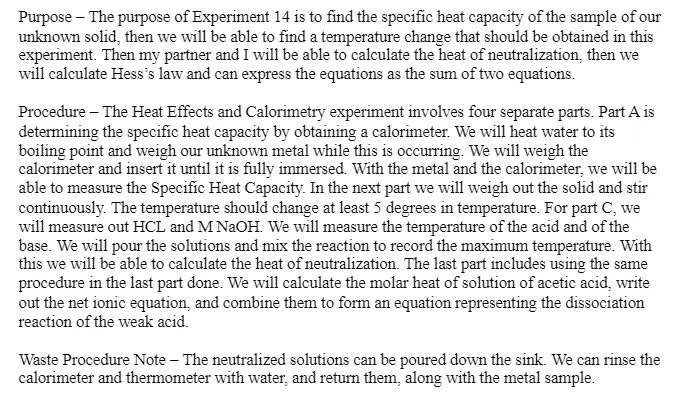
Heat Effects and Calorimetry Advance Study Assignment Examples
The Studocu presents an example that can be helpful for many learners. Find below its introductory part.
7. Ask For Help
Students’ timetable is usually packed up with various responsibilities. It might be about completing multiple projects with tight deadlines, or you may be involved in a part-time job. Also, they may have trouble grasping the subject specifications because of the difficult ideas. If you are aiming for academic success and getting good marks, then it is advisable to buy assignments online to get rid of these constraints. It will not only satisfy your urge to achieve a good CGPA but also keep aside the fear of failing.
Conclusion
Writing heat effects and calorimetry advance study assignments can be helpful, especially if you are struggling with comprehension of a subject. It helps in gaining insights that seem impossible to grasp with theoretical learning. When you write those ideas, it demonstrates your learning ability and provides room for thinking out of the box. In the above discussion, you have labelled the expert tips that students must be aware of before they start writing their assignments. It may involve planning, analysing the central theme, conducting deep research, writing a compelling introduction, etc. This way, you can avoid the obvious errors that most students make while writing such documents.

Online learning offers unparalleled flexibility and convenience, allowing students to pursue education from anywhere in the world and at their own pace. However, with this flexibility comes the responsibility of managing one’s time effectively to ensure productivity and academic success.
Effective time management is crucial for online learners to balance coursework, assignments, and other responsibilities while maintaining a healthy work-life-study balance. This article will explore nine essential tips for effective time management in online learning to help students maximize their productivity, stay organized, and achieve their academic goals.
1. Establish a Structured Routine
Creating a structured routine is the foundation of effective time management in online learning. Set consistent daily or weekly schedules for studying, attending online classes, completing assignments, and other academic tasks.
Allocate specific time blocks for different activities, such as reading, writing, researching, and reviewing course materials, to maintain focus and productivity. By establishing a routine, you can develop disciplined study habits, optimize your productivity, and minimize procrastination.
2. Set Clear Goals and Priorities
Set clear academic goals and priorities to guide your online learning journey and stay focused on what matters most. Break down larger goals into smaller, manageable tasks and prioritize them based on deadlines, importance, and urgency.
Use tools such as to-do lists, task managers, or digital calendars to organize and track your goals and progress. By setting achievable goals and priorities, you can stay motivated, maintain momentum, and effectively manage your time to reach your academic objectives.
3. Create a Dedicated Study Space
Designate a dedicated study space that is conducive to learning and free from distractions. Choose a quiet and comfortable environment with minimal interruptions, such as a home office, study room, or library corner.
Ensure your study space is well-lit, organized, and equipped with essential study materials, such as textbooks, notebooks, and a reliable internet connection. By creating a designated study space, you can minimize distractions, optimize your focus, and enhance your learning experience.
4. Practice Effective Time Blocking
Time blocking is a powerful time management technique that involves allocating specific time blocks for different tasks or activities throughout the day. Divide your schedule into focused time blocks for studying, attending lectures, completing assignments, taking breaks, and engaging in other activities.
Set realistic time limits for each task and avoid multitasking to maintain focus and productivity. By practicing effective time blocking, you can optimize your schedule, prioritize tasks, and make efficient use of your available time.
5. Minimize Distractions and Interruptions
Identify and minimize distractions and interruptions that may hinder your focus and productivity during online learning sessions. Turn off notifications, mute irrelevant apps or websites, and silence your phone to minimize distractions from social media, emails, or text messages.
Communicate your study schedule and boundaries to friends, family members, or roommates to minimize interruptions and create a conducive learning environment. By minimizing distractions, you can maintain concentration, maximize productivity, and make the most of your study time.
6. Use Time Management Tools and Apps
Take advantage of time management tools and apps to streamline your online learning experience and stay organized. Use digital calendars, task managers, or productivity apps to schedule study sessions, set reminders, and track deadlines. Explore note-taking apps, online collaboration platforms, and academic resources to enhance your learning and productivity.
Try out various tools and applications to determine which ones best fit your requirements and tastes. By leveraging time management tools and apps, you can stay organized, manage your time effectively, and achieve your academic goals.
7. Break Tasks into Manageable Chunks
Break larger tasks or assignments into smaller, manageable chunks to avoid feeling overwhelmed and maintain momentum. Use the Pomodoro Technique or similar time management methods to work in focused intervals, alternating between periods of intense concentration and short breaks.
Break down complex tasks into smaller action steps and tackle them one at a time, focusing on making incremental progress. By breaking tasks into manageable chunks, you can reduce procrastination, boost productivity, and achieve greater efficiency in your online learning.
8. Practice Self-Care and Time for Rest
Prioritize self-care and allocate time for rest and relaxation to maintain overall well-being and prevent burnout. Incorporate regular breaks, physical activity, mindfulness practices, and hobbies into your daily routine to recharge and rejuvenate your mind and body.
Get an adequate amount of sleep each night, eat nutritious meals, and stay hydrated to support your physical and mental health. By practicing self-care and prioritizing rest, you can improve your focus, concentration, and overall productivity in online learning.
9. Stay Flexible and Adapt to Changes
Stay flexible and adaptable in your approach to time management, especially in dynamic and unpredictable online learning environments. Be prepared to adjust your schedule, priorities, and study strategies as needed to accommodate changes in coursework, deadlines, or personal circumstances.
By staying flexible and adaptable, you can navigate challenges effectively, maintain resilience, and continue progressing toward your academic goals in online learning.
Thrive in Online Learning
Effective time management is essential for success in online learning, allowing students to balance coursework, responsibilities, and self-care effectively. Students can maximize their productivity and meet their academic objectives by creating a dedicated study room, employing time management tools and apps, practicing efficient time blocking, reducing distractions, and building a disciplined routine.
Additionally, breaking tasks into manageable chunks, prioritizing self-care, and staying flexible and adaptable are crucial strategies for maintaining well-being and resilience in online learning environments. By implementing these time management tips, students can maximize their potential and thrive in the world of online education.
Want to learn more? Visit our website for more like this.

The thought of writing a book report may sound scary to you, but in reality, it’s not so. Writing it is very similar to writing the summary of a book, but it also contains a lot more details. It explains the plot of the story, the characters and the theme. You need to read all the chapters in detail and write about it. People mostly read a book report in order to decide whether they want or go through the book or not. Your report should be easy-to-read, but also you need to make it very engrossing, or else the reader might stop reading it. You may write the piece yourself or you may get it done by professionals.
Getting Professional Help
As a student you are already under a huge pressure of your studies and the innumerable essays and other homework that you need to submit. On top of all that, this report might be adding to your stress. If you want to take an essay writer’s help, you choose a reliable brand like AllEssayWriter service or similar high-rated brands.
You can also search on the internet for ‘write my book report’ services apart from AllEssayWriter. Choose the one you like and take their help to complete you report. You do not need to worry about the quality of the work that you will receive, as the professionals who will be working on it are experts in writing these.
Writing It Yourself
The most important thing that you need to do in order to write a book report is to read the book thoroughly. Do not leave out any detail. If possible, give it a read more than once so that you know everything in great detail. Then it will not be difficult for you to write a report about it.
A book report, like other essays, has three parts to it – an introduction, a body and a conclusion. The introduction marks the beginning to your report. You need to make it very interesting so that the person reading the report would want to know more about the book and read through the rest of your writing. In the body of the report you need to write about the summary of the book, along with details about characters and events.
Book Report Writing Prep
1. Read the Book
This is the first thing that needs to be done. Read the book properly, if required, more than once. You need to understand the plot progression and character development, so that you can write about it.
2. Take Notes
When you are reading the book, jot down the important points, names of characters, events, etc. Copy important quotes. Using these in your report will make it more interesting to read through.
3. Highlight
If you feel that you cannot copy down everything but instead want to mark sections in your book, you can also do that. Highlight important sections and quotes using coloured markers.
4. Draft
First, create a rough draft of the report. See whether you have included everything that you wanted to. Do not miss out on important points. Also check whether you have exceeded the specified word limit or not.
What to Include in a Book Report?
1. Name of Book and Author
The first thing that you have to write is the name of the Book, the full name of the Author and the number of pages it consists of. You should also add the date of publication and the name of the company which published the book.
2. Major Characters and Their Importance
Any story is based around a certain group of characters. It can be a single character, a duo, or more than that. You need to write about the characters. Describe them in detail – their features, their characteristics, everything about them. Why are they important in the book? How do they contribute to the development of the plot? Also, mention the names of the major characters.
3. Events that Took Place
The next thing that you need to include in your report is the events mentioned in the book. What do you think are the main events? Why do you think they are important? The event that you will be writing about could be a very simple one or a complex one. But it should someone help in plot advancement.
4. Time and Place
You also need to write about the setting of the book. Does the writer clearly mention the location of the time period the story was set it? Or does it mention it very vaguely? Knowing the location helps you to understand the lives of the main characters better.
5. Plot
The plot is how the story progresses from one event to another. You need to write about how the story moves forward, and how it affects the life of the characters. How good a plot is depends on how smoothly the story progresses from one event to another.
6. Genre
What kind of book do you think this is? Should it be classified as a thriller, a comedy, or something else? Is it a novel or a drama? You should also write about why this book belongs to that particular genre.
7. Your Analysis
Analyse the characters, the theme, the plot. What are your views regarding them? Explain them in detail. You should refer to the text from time to time, while writing down your views.
8. Quotes
While writing about your analysis, include quotes from the book. You can also use quotes in other sections of your writing, as and when you feel necessary. Just make sure that you mark the quotes.
Some Important Tips
- The name of the book and the author should be mentioned in the title of your book report.
- In the conclusion of your report, summarize the key points of your report. You can also include a small personal feedback about whether you like the book or not.
- If you teacher has provided you with some guidelines, follow them very diligently.
To Wrap It Up, Study the book on which you are writing the report very thoroughly. Remember that the introduction to the Book Report needs to be intriguing, so that the reader is interested to go through the whole article. Write about the characters, the setting, the location, what events take place and how the story progresses. Do not forget to mention the name of the book and the full name of the author.




 HOME IMPROVEMENT1 year ago
The Do’s and Don’ts of Renting Rubbish Bins for Your Next Renovation
- BUSINESS1 year ago
Exploring the Benefits of Commercial Printing
- HOME IMPROVEMENT10 months ago
Get Your Grout to Gleam With These Easy-To-Follow Tips

 HEALTH10 months ago
The Surprising Benefits of Weight Loss Peptides You Need to Know
- TECHNOLOGY1 year ago
Dizipal 608: The Tech Revolution Redefined
- BUSINESS1 year ago
Brand Visibility with Imprint Now and Custom Poly Mailers
- HEALTH10 months ago
Your Guide to Shedding Pounds in the Digital Age
- LAW1 year ago
7 Key Questions to Ask When Hiring a Criminal Lawyer







